Date
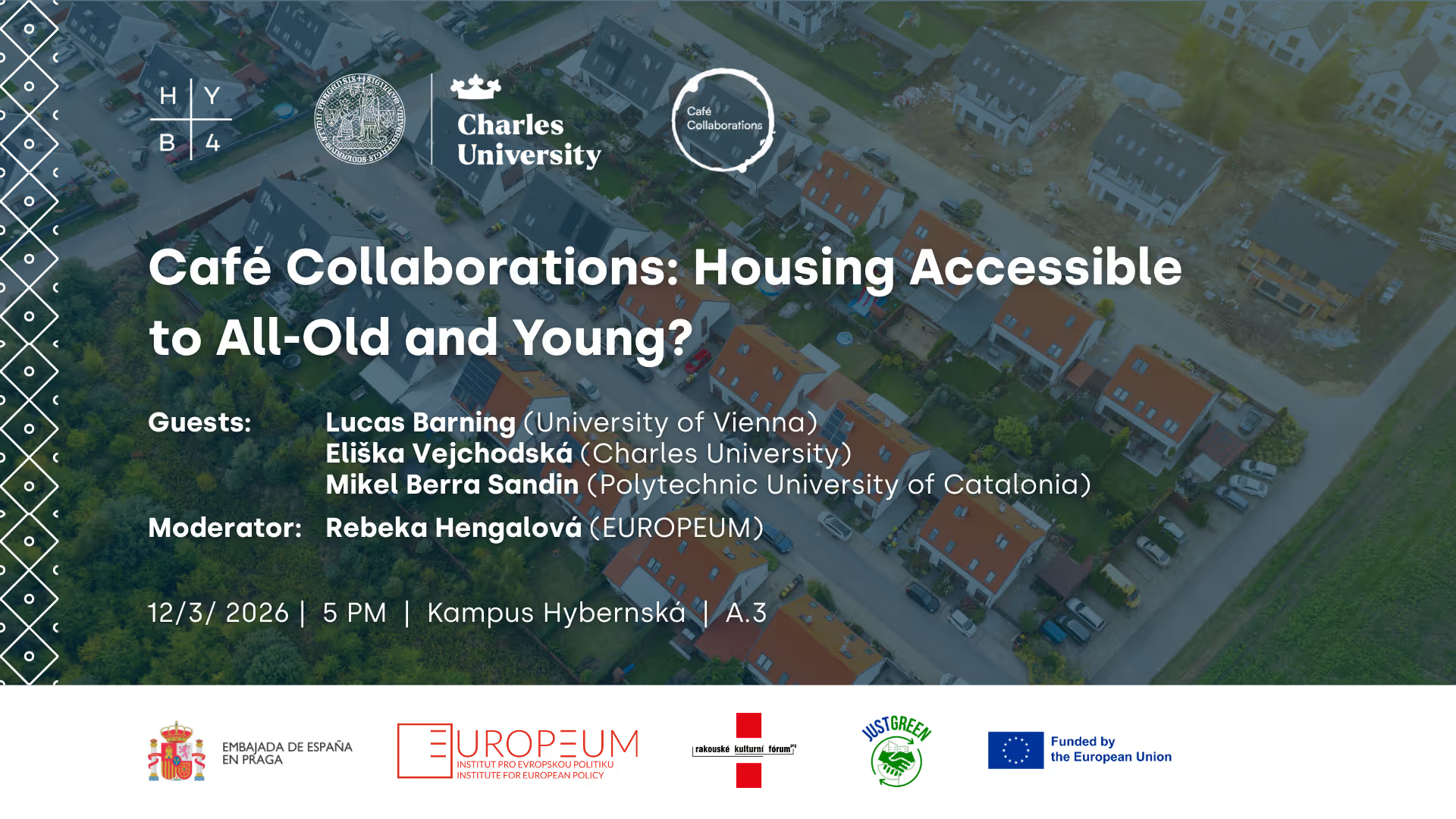
To finally have your own room. To rent it? To share a flat, buy an apartment, or a house? To live in the centre of the action—or to leave the city behind and move to the countryside? Should the state step in, or will the invisible hand of the market take care of everything?
What can we learn from Austria, Spain, and other European countries? Which strategies and policies have proven effective in making housing accessible to young families, low-income households, tenants, and other vulnerable groups—and in building an affordable housing stock for the long term?
These pressing questions as well as best practice examples from the Czech Republic, Austria and Spain will be discussed by:
- Lucas Barning (University of Vienna)
Lucas Barning is a geographer and planning scholar focusing on social theory, governance, and the social and political dimensions of energy systems. Since July 2024, he has been a member of the Working Group of Spatial Research and Spatial Planning and currently co-leads the Research Network on Eco-Social Policy and Practice for Innovation and Transformation. Mr. Barning studied Geography and Urban and Regional Development at the University of Bremen and completed his doctorate at TU Wien, Institute for Spatial Planning.
- Eliška Vejchodská (Charles University)
Eliška Vejchodská is an Associate Professor at the Faculty of Social Sciences at Charles University in Prague, where she focuses on land policy, environmental policy, and urban governance. Her research covers urban planning and the social and environmental dimensions of urban change, with particular attention to land value capture mechanisms. She has extensive experience in both academia and public administration. Her work combines academic insight with practical policy engagement.
- Mikel Berra Sandin (Polytechnic University of Catalonia)
Mikel Berra Sandin is an architect and urban planner, working at the intersection of urban development, housing policy and digital transformation. His research, developed at the Massachusetts Institute of Technology and at the Polytechnic University of Catalonia, focuses on European land use and housing. His latest work analyzes housing supply dynamics and planning frameworks across 23 major European metropolitan areas, with a special focus on Vienna and Prague.
Moderator: Rebeka Hengalová, Research Fellow of the Green Europe Programme.
Rebeka studied Socio-ecological Economics and Policy at the Vienna University of Economics and Business. Now, she focuses on transport poverty in the context of the Emission Trading System (ETS2) implementation and its mitigation through the Social Climate Fund.
The capacity is limited. Please, register here.

