Date
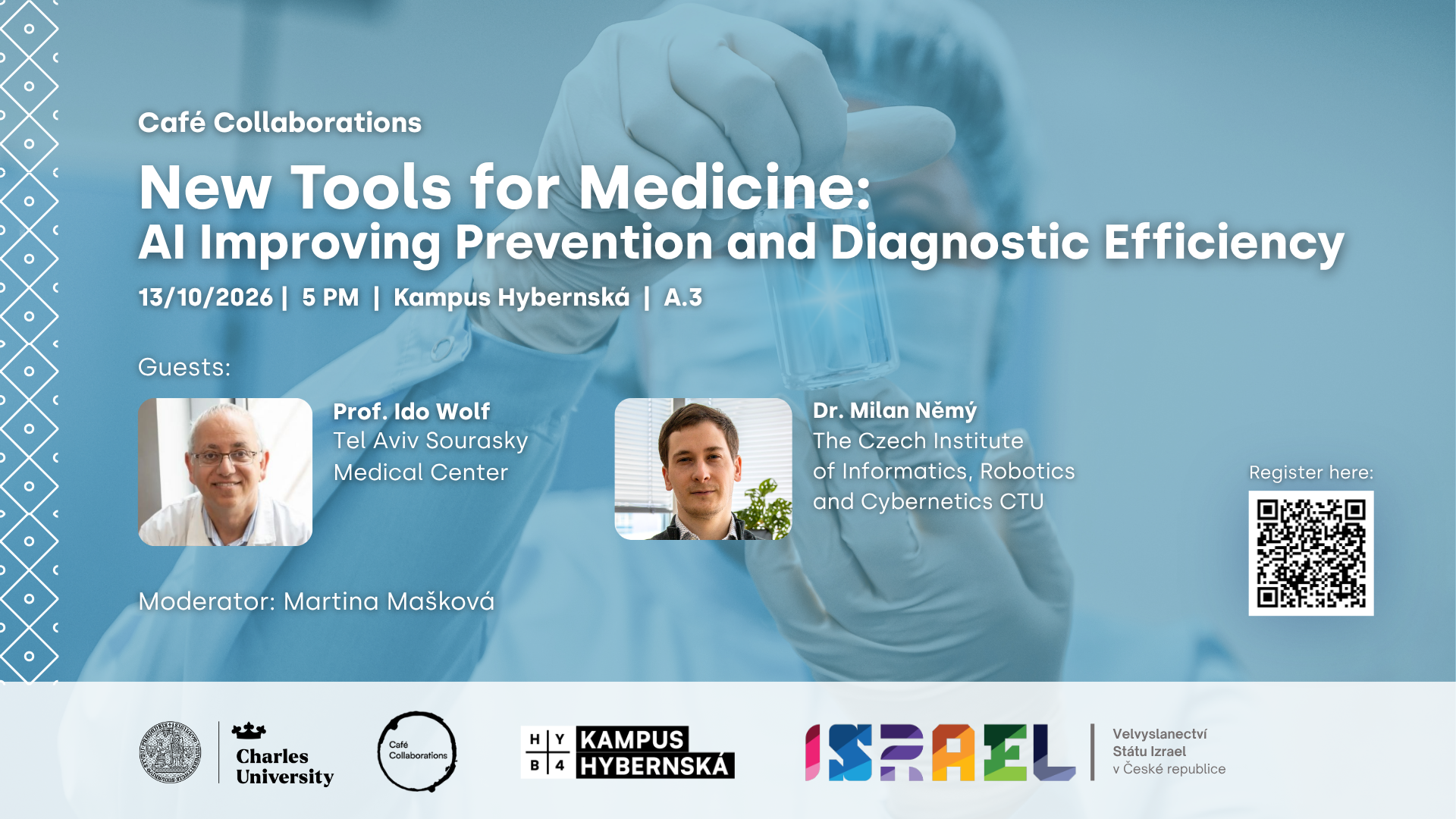
Artificial intelligence (AI) is rapidly becoming a valuable tool in medicine, with applications ranging from disease prevention to the early detection of malignant diseases. The implementation of AI-based approaches may provide substantial benefits and contribute significantly to improving preventive strategies and diagnostic efficiency.
One particularly promising area is brain research. Combined with modern magnetic resonance imaging methods, AI can detect subtle changes in brain structure and connectivity, helping us understand disease-related changes long before visible symptoms appear in conditions such as Alzheimer’s disease.
The potential of AI extends beyond diagnosis. Its integration into university education, as well as medical and other training programs, may also enhance learning and improve educational outcomes.
These topics will be discussed by leading experts from Israel and the Czech Republic.
Prof. Ido Wolf
Prof. Ido Wolf is an Israeli physician, medical oncologist, researcher, and academic leader with more than three decades of experience in medicine and oncology. He studied medicine at Ben-Gurion University of the Negev from 1984 to 1990. After completing his medical studies, he trained in internal medicine at Sheba Medical Center and subsequently specialized in medical oncology. Prof. Wolf’s medical expertise focuses on medical oncology and the diagnosis and treatment of complex cancers. He is also a physician-scientist and healthcare leader, combining clinical medicine, cancer research, medical education, and healthcare policy.
Dr. Milan Němý
Dr. Milan Němý has a background in engineering, with a degree in Cybernetics, Robotics and Biomedical Engineering from the Czech Technical University, followed by Ph.D. studies in Biocybernetics and Artificial Intelligence. He recently received a tenure-track position at the CLARA Center of Excellence in Bioinformatics and AI and also works as a researcher at Karolinska Institutet in Sweden. His research lies at the intersection of neuroimaging, computational neuroscience and artificial intelligence, with a particular focus on developing advanced imaging and computational methods to study the human brain and neurodegenerative diseases. He combines his research with teaching in biomedical engineering, programming and neuroimaging.
Martina Mašková
Martina Mašková is a Czech Radio presenter, producer, and science communicator. She studied journalism in Angers, France, and science education in Prague, Czech Republic. She has worked for the BBC in London and Prague, and her professional experience also includes placements at Radio France in La Rochelle and Deutsche Welle in Cologne. She is the author of radio documentaries produced in the Czech Republic, Germany, France, Switzerland, Israel, and Namibia.
The capacity is limited. Please, register here by October 10, 2026.

